










_(1)_1790176309817.png?w=900&format=webp)
If you've ever stood in a boat lot trying to decide between a pontoon and a tri-toon, you're not alone. It's one of the first questions our sales team asks every first-time buyer, and most people don't even know there's a difference. We sat down with Adam, one of our pontoon specialists, on Against the Current: The Lake Life Playbook to break down what actually separates these boats, what questions to ask yourself before you buy, and where the extra money goes. Here's what we covered. (Watch or listen to the full episode, "Pontoons vs. Tri-Toons: What First-Time Buyers Need to Know," linked below.)
Start With How You'll Actually Use It
Before you fall in love with a floorplan, figure out the basics: how many people are you regularly bringing on board, and what do you want to do once you're out there? Fishing, tubing, wakeboarding, or just cruising around with a cooler and some folding chairs all point you toward different setups.
Your lake matters too. A lot of the private lakes around here have strict horsepower restrictions, sometimes capping you at a 40 or 50 horsepower motor, which immediately narrows your options. Know your lake's rules before you start shopping, because it changes everything downstream.
Pontoon vs. Tri-Toon vs. Sport-Toon
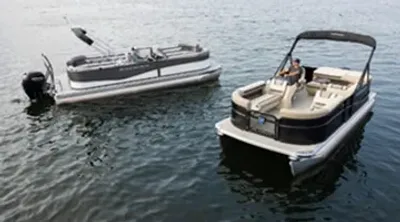
Here's the simple version: a standard pontoon rides on two tubes ("toons"). A tri-toon adds a third tube down the middle. A sport-toon splits the difference, a hybrid design that borrows a bit from each.
The tri-toon isn't just about looks. That third tube adds buoyancy, which matters more than people expect once you load a boat down with passengers, coolers, and gear. Without it, a fully loaded pontoon can sit low enough in the water that the deck starts feeling uncomfortably close to the surface. The extra tube keeps you riding higher, holds more people comfortably, and, thanks to the added lifting strakes most tri-toons come with, gives you a noticeably smoother, drier ride in choppy water. It also plants tubes and wakeboarders better and gets you up on plane faster.
If you're buying just to putz around a calm private lake with a couple of people, a standard pontoon might be all you need. If you're filling every seat, dealing with rougher water, or want to tow, the tri-toon earns its keep.
What's a Godfrey and Premier Pontoon Going to Cost?
Omaha Marine Center carries two lines, Godfrey and Premier, and they take pretty different approaches to how they price things out.
Godfrey builds a wide range, from the Mighty Jee (an ultra-compact 15 to 16 footer, now only built twice a year) up through the Sweetwater, Monaco, Aqua Patio, Sandpan, and XP. Godfrey isn't afraid to strip a boat down to basics, no confusing instrumentation, just what you need to get out on the water, which a lot of first-time buyers actually prefer.
As a rough guide: a Godfrey pontoon with a 50 horsepower motor and no trailer starts around $40,000. Step up to a tri-toon with a 150 horsepower motor and a trailer, and you're generally looking at the low to mid $60,000s to high $70,000s depending on the model and options.
Premier takes a different philosophy. Even their entry-level Sunscape comes loaded with more standard features than you'd get on a comparable Godfrey. Their lineup runs Sunscape, Sunsation, Solaris, Intrigue, Escalante, and the SS series, plus their standout PTX tri-toon, which our team says handles noticeably better than any other tri-toon on the water, with better maneuverability and the ability to actually pitch and roll through turns and lift the bow, instead of the typical pontoon "plow and flop." Premier is a family-owned company that leans into innovation, things like the Stow N' Go storage system, Angler open-water panels, and a rear social seating area with a TV mount.
Bottom line: both brands offer real range, but Godfrey goes lower into the economy end, while Premier starts a notch higher and focuses on features.
Layouts People Actually Want
The split-bench layout has become the clear favorite. It pushes seating to the outer edges and opens up a wide walkway down the center, so it's easy to move front to back. Flip-lounge layouts look great and are popular for a reason, but that fold-out bed eats up a lot of walking space and can make the boat feel tight, especially getting around the driver's seat.
One thing worth knowing for families with young kids or dogs: some of the more open, high-end layouts have exposed rear gating that can be a little nerve-wracking. The good news is aftermarket safety gates can be added if that's a concern.
Small Features That Make a Big Difference
A few things our team recommends every buyer at least consider:
A basic depth readout. Most of our area lakes run shallow, and while pontoons float on top of the water, a simple depth number (not a $2,000 fish finder) helps new boaters avoid flying blind. It's cheap, and almost everyone who skips it ends up adding one later anyway.
In-floor ski/wakeboard storage. This is usually a factory option rather than standard, since it means cutting into the center tube. It's genuinely nice to have (Premier's larger storage door even fits a full-size wakeboard), but if you're at a private lake where gear goes back in the garage every night, it's not a must.
Tow bar weight limits. If you plan to pull tubes or skiers, read the weight rating on your tow bar. Most cap out around 350 to 450 lbs. Many tow bars are mounted straight into the plywood deck, which isn't a warranty item if it fails from overloading. If you're going to tow seriously and often, a Turbo Swing setup (mounted more like a truck tow package) is a sturdier, purpose-built option.
Motor sizing. More horsepower isn't automatically better. On shorter pontoons (around 20 feet), a big motor like a 150 can actually throw off the boat's balance and hurt performance. On longer boats, 24 feet and up, that extra power makes sense because the weight is distributed more evenly. This is one of many reasons buyers often end up choosing a tri-toon once they start asking these questions.
Electric Pontoons
For electric-only lakes, newer motor options, like Mercury's drop-in battery system, have made electric pontoons far more practical. Instead of managing four deep-cycle batteries wired in a specific sequence, you drop in a single battery pack at the back of the motor. Simpler setup, fewer battery headaches.
Don't Forget the Trailer (and the Zebra Mussels)
More lakes are now requiring boats to have their own dedicated trailer, largely to prevent zebra mussels and other invasive species from spreading between lakes. It can feel like an extra cost up front, but it typically pays off. It's easier and cheaper to store your boat on its own trailer long-term than to keep renting one, and tri-toons in particular tend to resell well specifically because most buyers in that market want a trailer boat.
One tip that trips up a lot of first-time buyers: the listed boat length (LOA) often doesn't include add-ons like a 2-foot rear extension, and the trailered length, including the tow bar, is longer than people expect. A 22-foot pontoon can trailer out at close to 30 feet. If you're planning garage storage, measure your garage door height, not just the depth. You'll need roughly a full 10-foot door to get a pontoon through.
Warranty
Both Godfrey and Premier back their pontoons with a 10-year tip-to-tail warranty from the deck up, and a lifetime warranty from the deck down, currently the longest warranty offered by any pontoon manufacturer.
One More Option: The Hurricane Fun Deck
If you're torn between a pontoon's open interior and a boat that performs more like a traditional hull, it's worth a look at Hurricane's Fun Deck series, a fiberglass-hull deck boat with a pontoon-style layout on top. It performs closer to a comparable I/O boat (our demo model comes in a 24-foot version with 300 horsepower) while still giving you that open pontoon-style interior space, and it lands right around the same price point as a similarly sized tri-toon.
The Takeaway
There's no single "right" pontoon. It really comes down to your crew size, your lake's restrictions, and what you actually want to do out there. But if you ask most first-time buyers enough of the right questions, the answer very often lands on a tri-toon.
If you want to talk through your specific lake, your budget, and what layout makes sense for your family, stop by Omaha Marine Center. Adam and our team are happy to walk you through the Godfrey and Premier lineups in person.
Listen to the full episode: YouTube | Spotify | Apple Podcasts | Amazon Music